
Last Updated on 8 months ago by Dr Alisha Barnes
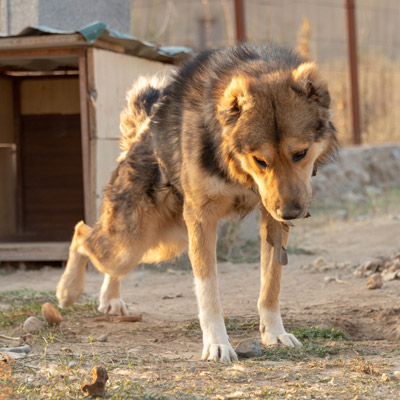
If your dog is stiff in the morning but seems better after warming up, you’re witnessing one of the earliest and most important warning signs of developing mobility problems. This pattern isn’t just “normal aging” – it’s your dog’s body telling you something specific is going wrong.
Let’s explore what’s really happening while your dog sleeps and what you can do to help them wake up comfortable again.
1. Arthritis and Joint Inflammation
Arthritis is the leading cause of morning stiffness in dogs. Degenerative joint disease affects hips, knees, elbows, shoulders, and spinal joints – often multiple locations simultaneously.
Why arthritis causes morning stiffness specifically:
- Cartilage breakdown creates rough joint surfaces
- Inflammation increases when joints stay still overnight
- Synovial fluid thickens during rest periods
- First movements are the most painful until joints “warm up”
Affected joints in order of frequency:
- Hips and lower spine
- Knees (stifles)
- Elbows
- Shoulders
- Wrists and ankles
Large breed dogs face higher arthritis risk due to their size and joint stress. But we regularly see arthritis-related morning stiffness in dogs of all sizes, especially those over seven years old.
The frustrating part? By the time you notice stiffness, arthritic changes have usually been developing for months or years. That’s why early intervention matters so much.
2. Spinal Joint Restriction and Misalignment
This is where animal chiropractic becomes essential and it’s often completely overlooked by conventional veterinary care.
Restricted spinal joints lose normal motion range over time. During sleep, these restricted areas essentially “lock up” even more, leaving dogs feeling stuck and hesitant when they first wake up.
How spinal restrictions create morning stiffness:
- Individual vertebrae don’t move through proper ranges
- Surrounding muscles tighten to protect restricted areas
- Nerve flow gets interrupted at restriction sites
- The entire body compensates for spinal dysfunction
Why dogs seem “locked up” first thing: Hours of stillness allow restricted joints to stiffen maximally. Movement gradually works the joints loose again, but the underlying restriction remains.
What’s remarkable is how spinal stiffness affects the entire body. A restriction in your dog’s mid-back can create compensatory stiffness in their hips and shoulders. Addressing the spine often resolves stiffness in multiple areas simultaneously.
3. Intervertebral Disc Degeneration
Intervertebral discs are the cushions between vertebrae. As dogs age or experience injuries, these discs dehydrate and lose their shock-absorbing capacity.
What happens to discs overnight:
- Discs naturally rehydrate slightly during rest (this is normal)
- Degenerated discs swell unevenly when rehydrating
- Swollen, stiff discs compress nearby nerves
- Morning brings the most nerve compression and stiffness
Early disc disease warning signs:
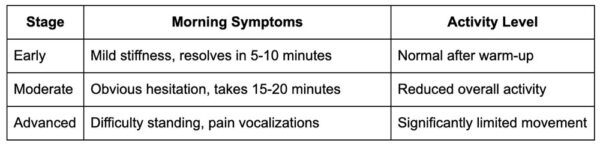
Catching disc problems at the early “morning stiffness” stage gives you the best chance of managing them conservatively without surgery.
4. Muscle Tightness and Poor Circulation
As dogs age, muscle tissue loses elasticity – a natural process accelerated by inactivity and spinal problems.
Age-related muscle changes:
- Collagen fibers become less flexible
- Muscle blood flow decreases during rest
- Recovery time after activity lengthens
- Muscles stay contracted longer, creating chronic tightness
Why warming up restores motion temporarily: Movement increases blood flow, delivering oxygen and flushing out metabolic waste products. Warmed muscles regain some lost elasticity, allowing more comfortable movement.
But here’s the catch: if muscle tightness is secondary to spinal dysfunction or joint problems, stretching and warming up only provide temporary relief. You need to address the root cause.
5. Previous Injuries and Scar Tissue
Old injuries – even ones from years ago – often resurface as morning stiffness in aging dogs.
How past trauma creates current stiffness:
- Scar tissue forms at injury sites
- Scar tissue is less flexible than normal tissue
- Old injuries stiffen first during rest periods
- Dogs develop compensatory movement patterns around old injuries
We frequently see dogs who had knee surgery five years ago now showing morning stiffness in that leg plus the opposite hip. Why? Because they’ve been compensating for subtle changes in that surgical leg for years.
Common injury types that resurface:
- ACL tears (even after surgical repair)
- Hip dysplasia corrections
- Fracture repair sites
- Soft tissue strains never properly rehabbed
The body remembers every injury. As dogs age and overall mobility declines, those old weak points become stiff points.
6. Early Neurological Compression
Sometimes what looks like stiffness is actually subtle neurological dysfunction – nerve interference causing coordination problems rather than pain.
How nerve compression appears as “stiffness”:
- Mild spinal cord pressure reduces signal clarity
- Dogs move slowly and carefully, not confidently
- Coordination is off, so movements appear stiff
- This often progresses to more obvious weakness later
Subtle neurological warning signs:
- Dragging rear toenails occasionally
- Slight swaying when standing still
- Hesitation on stairs (more than just pain)
- Crossed-over hind leg placement when walking
7. Inactivity and Deconditioning in Senior Dogs
This creates a vicious cycle: dogs move less because of discomfort, muscle loss accelerates due to inactivity, and muscle loss makes movement even more uncomfortable.
The deconditioning spiral:
- Reduced activity → Muscle atrophy
- Muscle atrophy → Core weakness
- Core weakness → Spinal instability
- Spinal instability → More pain and stiffness
- More stiffness → Even less activity
Why inactive dogs stiffen faster: Without regular movement, joints don’t receive adequate nutrition (cartilage depends on movement for nutrient delivery). Muscles shrink and tighten. Balance deteriorates. Everything becomes harder.
Breaking this cycle requires addressing both the pain causing inactivity AND rebuilding strength through appropriate exercise.
How Chiropractic Care Helps Dogs Move Better in the Morning
Let’s talk specifically about how animal chiropractic addresses morning stiffness in dogs. The four-way approach to reducing stiffness:
- Improving joint lubrication through motion: Gentle adjustments restore proper joint movement, which stimulates synovial fluid production. Better lubrication means less morning stiffness and faster warm-up times.
- Reducing spinal restriction: We identify and correct restricted vertebrae, allowing the spine to move fluidly again. When spinal motion normalizes, compensatory stiffness throughout the body often resolves.
- Enhancing nerve-muscle coordination: Adjustments remove nerve interference, restoring clear communication between brain and muscles. Dogs move more confidently and smoothly from the moment they wake up.
- Helping dogs rise faster and more comfortably: Improved joint function, muscle activation, and nerve flow combine to make standing up easier. Many dogs show visible improvement in morning rising patterns within just a few sessions.
Can Morning Stiffness in Dogs Be Prevented?
The short answer is yes – or at least significantly delayed – with proactive care.
Regular spinal mobility checkups: Just like dental cleanings, preventive chiropractic evaluations catch small restrictions before they become big problems. We recommend senior dogs get checked every 4-6 weeks.
Maintaining activity with age: Appropriate exercise keeps joints lubricated, muscles strong, and weight controlled. “Appropriate” means low-impact activities like swimming, controlled leash walks, and gentle play – not high-impact jumping or running on hard surfaces.
Early intervention before degeneration progresses: If you’re seeing occasional morning stiffness now, addressing it immediately can prevent progression to chronic, severe arthritis. Conservative care works best in early stages.
Long-term mobility planning for senior dogs: Work with your veterinarian and animal chiropractor to create a comprehensive plan including nutrition, supplements, exercise, and regular bodywork. Prevention costs far less than treating advanced disease.
Help Your Dog Wake Up Comfortable Again
Watching your dog stiff in the morning, moving like they’ve aged overnight, is heartbreaking. But this pattern doesn’t have to be your dog’s new normal.
Morning stiffness improving with movement tells us the problem is mechanical – joints, muscles, and nerves not functioning optimally. And mechanical problems respond beautifully to conservative care addressing the root cause.
At Tails Animal Chiropractic Care in Fort Collins and Broomfield, we’ve helped countless dogs move from painful, stiff mornings to comfortable, confident starts to their day. Often without a single medication.
Ready to help your dog feel young again? Schedule a comprehensive mobility evaluation. We’ll identify exactly what’s causing the stiffness and create a personalized plan to get them moving comfortably from the moment they wake up.