
Last Updated on 2 months ago by Dr Alisha Barnes
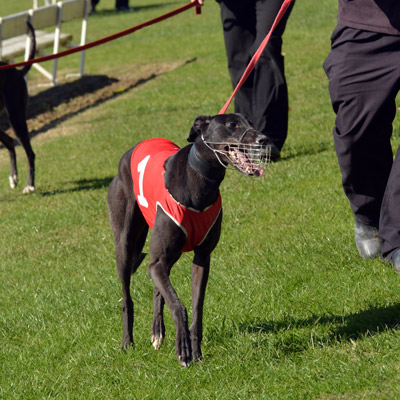
Sports injuries in dogs happen far more often than most owners expect. Your dog will rarely tell you something hurts. They will keep running, keep jumping, and keep trying to please you, even while a small strain quietly gets worse. Knowing what to watch for, what to do first, and how recovery actually works can protect both your dog’s body and their love of the sport.
Signs your dog may have a sports injury
One of the earliest signs of a sports injury is often a change in performance rather than an obvious limp. Many owners notice that something feels different before they can identify exactly where their dog is hurting. Watch for these changes:
- Slower performance during training.
- Knocking bars or refusing obstacles.
- Taking wider turns.
- Hesitating before jumps.
- Limping improves after warming up but returns later.
- Shorter strides on one side.
- Reluctance to jump into the car or climb stairs.
- Sitting with one back leg out to the side.
- Licking the same paw, toe, or groin repeatedly.
- Pulling away when touched.
- Losing enthusiasm for activities they normally enjoy.
Dogs naturally hide pain, and active sporting dogs often hide it even better because they are eager to keep working.
What counts as sports injuries in dogs
Most sports injuries in dogs are soft tissue problems rather than broken bones. A strain is damage to a muscle or a tendon, the tissue that ties muscle to bone. A sprain is damage to a ligament, the tissue that holds two bones together at a joint. Both come from the same cause: force that is bigger, faster, or more repeated than the tissue is ready for.
Less often, a hard landing or a collision causes a fracture, a dislocation, or a torn nail. And in some athletic dogs, no single moment causes the problem at all. Repetitive stress wears a tendon or a joint down slowly, until the body finally speaks up.
Where sporting dogs get hurt
Sports injuries often affect the same areas of the body. Knowing where injuries commonly happen can help you recognize problems earlier and explain your dog’s symptoms more clearly to your veterinarian.
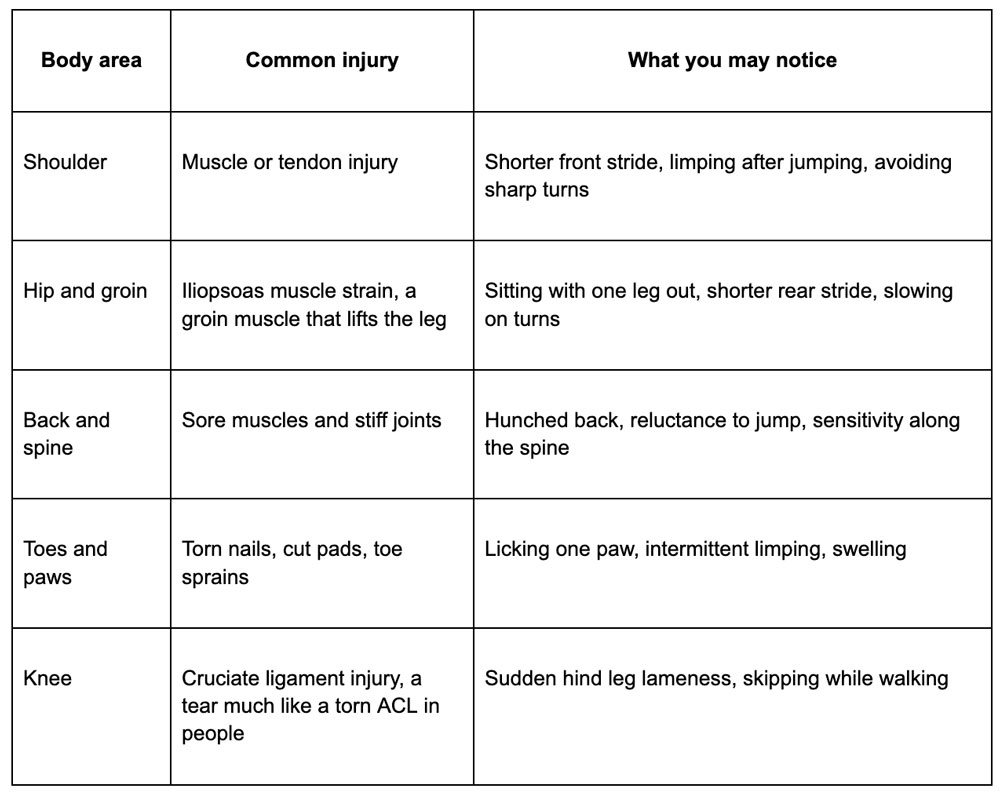
Your dog’s paws are the easiest area to check yourself and the easiest to overlook, so start there whenever they come off the field sore.
Which dogs get hurt most often
Any dog can pull a muscle chasing a ball, but the risk climbs with speed, height, and repetition. A survey of more than 1,500 competition dogs in Sweden found that over half had been injured at some point, and the spine, paw, shoulder, and knee came up as the most common places. Border Collies and Belgian Malinois showed higher odds of an injury history than other breeds, and older dogs were at higher risk than young ones.
Labrador Retrievers, German Shepherds, and other working dogs land on that list too. Sport matters as much as breed. Agility loads the shoulders and the spine, dock diving loads the back and the front legs on landing, and field work wears on the hips over long days. Weekend only athletes get hurt more often than dogs who train steadily all year.
What to do right after an injury
Stop the activity. Do not let your dog finish the run, the retrieve, or the hike. A mild muscle strain that gets pushed for another ten minutes can turn into a much longer recovery time.
Keep your dog calm and still, and look at the paw and nails first, since those are quick to check and easy to overlook. Leash walks only, no stairs, no ball, no couch jumping. If there is heat, swelling, obvious pain, or your dog will not put weight on a leg, consult a veterinarian right away. Never give human pain medication. Many of those drugs are dangerous for dogs even in small doses.
For anything more than a mild, short lived limp, a full exam comes first. Your veterinarian can rule out a fracture, a ligament tear, or an orthopedic problem that needs surgery, and that diagnosis shapes everything that follows.
How recovery and rehabilitation work
Rest is the starting point, not the whole plan. Muscles begin to lose strength within days of going quiet, so a dog who simply sits in a crate for six weeks often comes back weaker and more likely to get hurt again.
Good rehabilitation replaces uncontrolled activity with controlled activity. Depending on the injury, your veterinarian or rehabilitation team may use underwater treadmill therapy, laser therapy, targeted strengthening, and range of motion work to rebuild the tissue so it can handle sport again. Physical rehabilitation after surgery looks nothing like rehabilitation for a pulled muscle, and the timeline is set by tissue healing, not by the calendar or the trial schedule.
Return to sport should be gradual. Full speed, full height, and full duration all come back in stages, and the last stage is the one people rush most often.
How chiropractic care fits into canine sports medicine
Chiropractic care works alongside veterinary medicine and rehabilitation, not in place of them. After an injury, many dogs shift their weight to avoid pain, which can place extra stress on other joints, muscles, and the spine.
Animal chiropractic uses gentle, specific adjustments to restore normal joint motion, reduce muscle tension, and improve overall movement. As part of a complete recovery plan, it can help reduce stiffness, support mobility, and help active dogs return to their favorite activities more comfortably.
Preventing sports injuries in dogs
Prevention is where handlers have the most control.
Warm up and cool down every time. Five minutes of walking and trotting before a run, and five minutes of easy walking after, prepares muscle and tendon for load and helps them settle afterward.
Condition for the sport, not just in the sport. Proper conditioning between competitions builds the strength and balance that trials demand. Weekend only athletes get hurt more often than steadily conditioned ones.
Keep your dog lean, respect their age, and do not overtrain. Fatigue is where form breaks down, and broken form is where injuries start. Regular chiropractic checkups during the season can help identify small movement restrictions before they develop into bigger problems.
Get your canine athlete back in the game
Getting back to sport is about more than simply waiting for an injury to heal. Dogs perform their best when they recover with good movement, balanced strength, and healthy joint function.
At Tails Animal Chiropractic Care, we work alongside your veterinarian to help active dogs recover safely and move at their best. Dr. Alisha Barnes, who is certified by the American Veterinary Chiropractic Association (AVCA), provides animal chiropractic, veterinary acupuncture, Traditional Chinese Veterinary Medicine (TCVM), and red light therapy to support dogs recovering from sports injuries and those participating in agility, flyball, dock diving, field trials, and other sporting or working activities.
We also offer home visits throughout Colorado’s Front Range, making it easier for dogs to receive care in a familiar, low stress environment.
If your dog is recovering from a sports injury or simply isn’t moving like they used to, we’re here to help them return to the activities they love.
Call us to schedule an assessment or book an appointment online.
Frequently asked questions
How long does a dog sports injury take to heal?
A mild muscle strain often settles in two to four weeks with rest and controlled activity. Ligament tears and fractures take months and usually need medical treatment first, with rehabilitation layered in as the tissue heals.
Can my dog compete again after an injury?
Most dogs return to their sport once they have healed fully and rebuilt strength. The safest path is a staged return guided by your veterinarian, with conditioning restored before speed and height come back.
Is chiropractic care safe for an injured dog?
Yes, when it is done by a certified animal chiropractor after medical issues have been ruled out. We assess before we adjust, and we refer back to your vet whenever an injury needs medical or surgical care first.